

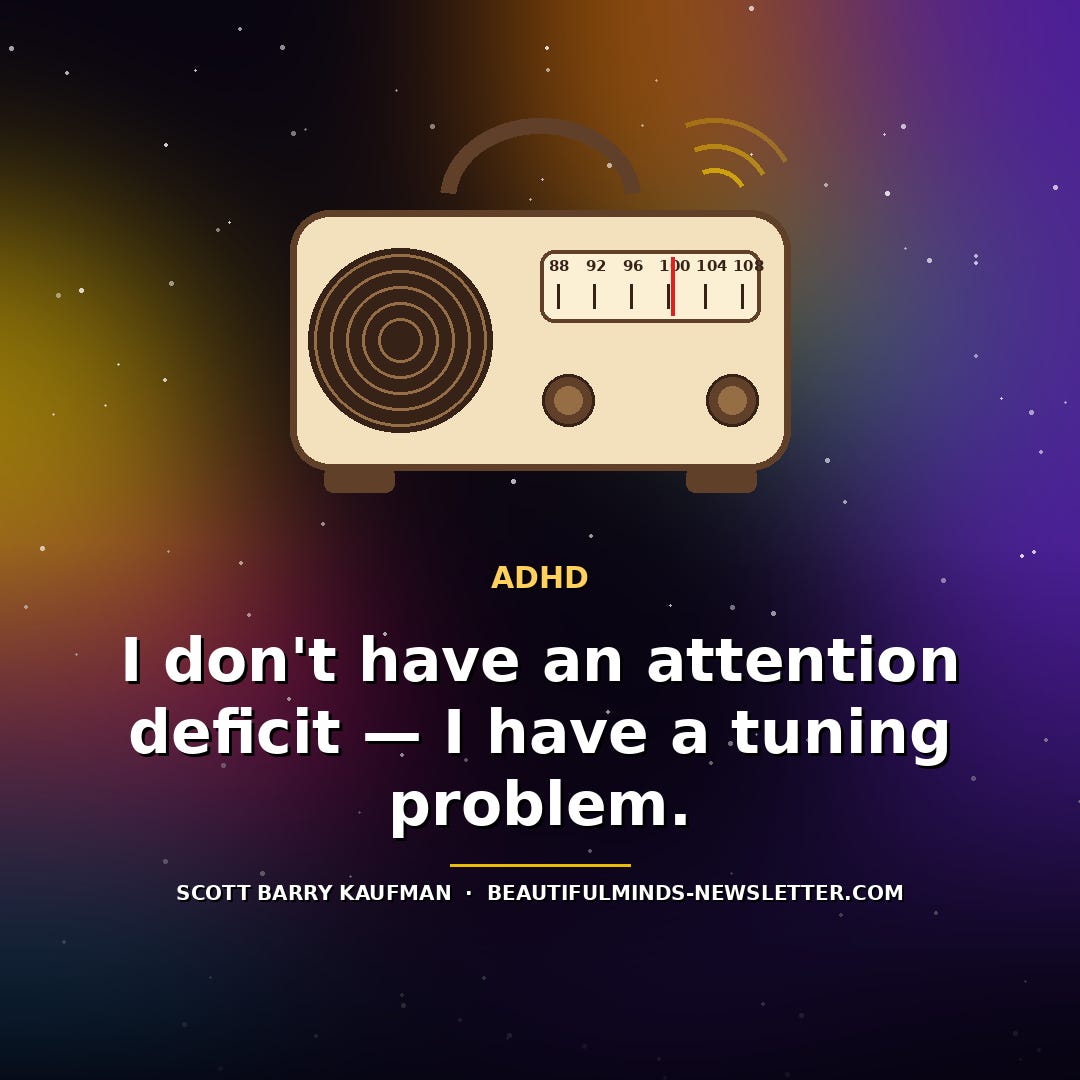
I think the medical establishment has ADHD all wrong.
It hit me the other day in the shower: the truest description of the ADHD mind isn’t a deficit at all — it’s a radio. While I’ve never been formally diagnosed, I know this dial intimately, from the inside. Let me tell you what it actually feels like. I suspect a lot of my readers will relate.
We named ADHD “attention deficit.” But it was never a shortage of attention. When I’m tuned in, I have more of it than almost anyone I know. The trouble is the *tuning* — finding the frequency, and leaving it there.
The ADHD manuals barely mention the other half of this: hyperfocus. Researchers call it “the forgotten frontier of attention.” People with this kind of mind don’t just lose focus more easily — they lock on harder, and catch the faint, weird, faraway signals everyone else has tuned out. A lot of creativity comes from exactly that.
New on Beautiful Minds: “ADHD: The Hard Part Isn’t Focus — It’s Choosing the Station.” If you know this dial, this one’s for you. beautifulminds-newsletter.com
#ADHD #hyperfocus #neurodivergence #creativity #attention #mindwandering #flow #daydreaming #executivefunction #selfacceptance #psychology #BeautifulMinds
When I finally lock onto something, the world narrows to a single bright band of signal. The room goes quiet, not because it’s silent but because I’ve stopped receiving it. Hours collapse into what feels like twenty minutes. Someone can say my name twice and I won’t surface; the thing I’m working on has become the only station broadcasting, and it’s coming through at full volume, crystal clear, no static. I am not trying to concentrate. There is nothing effortful about it. I am simply, completely, there. People sometimes call this discipline. It isn’t. It’s closer to being pulled under.
That’s one half of my attention. The other half is the part nobody romanticizes: I often can’t choose which station to tune to in the first place. Using the language of Kierkegaard, I often (too often) drown in the sea of possibility. I’ll sit down with twelve worthy things to do and the dial just spins: a smear of half-caught signals, no single one resolving, a low anxious hum of everything-at-once. For me, and I suspect for so many of my readers, the trouble was never a shortage of attention. When I’m tune in, I have more of it than almost anyone I know.
The trouble is the tuning itself: choosing the frequency, and then leaving it there.
I think this is the part we get backwards.
We named it “attention deficit,” as if the problem were an empty tank. But as the authors of one of the few serious reviews of the subject put it, “despite its seemingly self-descriptive name, ADHD is not solely a disorder of attention.” It’s a disorder of regulating attention: of allocation, of selection, of getting the dial to land and hold. And the flip side of that, the part the diagnostic manuals barely mention, is the thing those same researchers call hyperfocus: “the forgotten frontier of attention.” People with ADHD don’t only lose focus more easily. They also lock on harder, and more often, than everyone else. The deficit framing only ever describes the spinning dial. It has nothing to say about the signal coming through at full strength.
What a signal it can be! When the station is the right one, what pours through isn’t just concentration — it’s a particular kind of mind. A growing body of research is finally taking the strengths seriously instead of only the struggles. A 2026 systematic review by Biqing Chi, Rebecca de Leeuw, Marieke Fransen, and Martine Hoogman at Radboud University — “Character Strengths in People with ADHD: A Systematic Review” — pulled together 59 studies and kept surfacing the same cluster: elevated curiosity, creativity, and a restless kind of zest (alongside the real costs, like lower self-regulation and perseverance). While it’s still a preprint (so hold the findings lightly), I find this to be a very important line of research with promising results.
Years ago I wrote about this in “The Creative Gifts of ADHD” for Scientific American. I wrote about the way a mind that won’t stay neatly on the assigned channel is also a mind that keeps catching the faint, weird, faraway frequencies everyone else has tuned out. I was taken then by Darya Zabelina’s finding that real-world creative achievers tend to have a “leaky” attentional filter: they let in the noise the rest of us screen out, and some of that noise turns out to be signal. Divergent thinking. Original ideas. The willingness to wander off the dial and find something nobody else was looking for.
This is also why I’ve never thought “creative” and “scattered” were opposites. As they say, a wandering mind is not always lost. In Wired to Create, Carolyn Gregoire and I argued that the creative mind runs on a kind of cognitive both/and: it generates wildly and it evaluates ruthlessly, alternating between the two. The generating half, the part that throws off sparks and chases tangents, looks an awful lot like the ADHD mind on a good day. The hard part, for all of us, is the switching: knowing when to stop generating and start choosing. Knowing which station, of all the ones now lit up, is the one worth staying on.
Because there is a real cost here, and I don’t want to wave it away. The same research that finds the curiosity and the creativity also finds the other half of the ledger: lower self-regulation, less perseverance, a harder time with the boring-but-necessary tasks of everyday life.
Executive function (the brain’s air-traffic control for inhibition, working memory, task-switching) is genuinely harder to come by, even if (and this matters) it isn’t equally impaired in everyone who’d meet the criteria. The gift and the difficulty aren’t two different people. They’re the same dial. The thing that lets you disappear into the signal is the same thing that won’t let you change the channel when dinner’s on the table and your kid is calling your name for the third time.
Now, here’s where I part ways, a little, with some of my colleagues.
When I’m in it, it certainly feels like flow. It feels like exactly what Mihaly Csikszentmihalyi described in Flow: the self dissolving, time bending, the sense of being used by the work rather than doing it. This isn’t a new hunch for me. The “Imagination Network” is my name for the brain’s default mode network, the wellspring of daydreams and self-generated thought, and it’s the network an ADHD mind has the hardest time quieting.
In research I’ve published with Roger Beaty, we found that creative idea production depends on the coupling of that imaginative network with the brain’s executive-control system: the generating and the steering, firing together. The same network that floods an ADHD mind with signal is the one creativity runs on, and the one that carries flow. The researchers who wrote that hyperfocus paper landed in roughly the same place: they concluded that flow and hyperfocus “appear to be the same phenomena, just with different names,” reported by different fields that never compared notes.
But plenty of careful scholars are adamant that they’re different, and I want to be fair to them, because their point isn’t trivial. Flow, in the classic sense, is voluntary and redirectable; you can come up for air. It tracks the sweet spot between challenge and skill. It tends to leave you better off. Hyperfocus, they argue, looks more like perseveration: you can get locked onto something pointless as easily as something sublime, you can’t always pull yourself out, and you lose three hours you needed. In ADHD samples, the felt overlap between the two turns out to be surprisingly modest. So the clinicians warn, reasonably: don’t romanticize the lock-on. Sometimes the station you can’t leave is just noise.
I hold both of these views at once (surprise surprise). I suspect the truth is a spectrum — shallow flow shading into deep flow shading into the kind of absorption that won’t let go — and I think the experts are right to flag the failure mode. But I also think the inner experience is real data, not an illusion to be corrected. When it feels like flow, something true is being reported about what’s happening in there. We don’t have to choose between the neuroscience and the experience. In my view, we can keep both.
Which brings me to the question I keep circling, the one about labels.
I’ve wondered, honestly, whether I’m also a little bit on the autism spectrum — whether some of that detail-drunk, won’t-let-go absorption is more than ADHD alone. I could go get evaluated. I suspect I’d qualify for something, or more likely a lot of things.
But the longer I sit with it, the less the precise label seems to matter, and the more I want to just describe the experience— because I don’t think it belongs only to the people with the diagnosis. I think a lot of you know this dial. If you know, you know! You know the glory of being tuned all the way in. And, you know the misery of standing in front of the receiver, every station lit, unable to commit to one. You’ve felt both, maybe in the same afternoon.
So I’ll leave the diagnosis to the diagnosticians. What I can tell you is the experience of it, from the inside: the problem was never that I can’t pay attention. It’s that my attention, once it catches a frequency, becomes the whole sky — and the real work of my life has been learning, slowly, which station to choose, and how to forgive myself for the generous static in between.
YES!
Funny that the metaphor is so simple, yet so profound.
It feels exactly (experience!) as you say. And a lot of the times we struggle because we find a lot of frequencies interesting! And to choose one is at times excruciating.
And I love how you pose the point of experiencing it rather than just go right ahead and finding a diagnostic.
In my case, I first got the diagnosis for HSP from a colleague that just met me and "saw it". Afterwards, another colleague started to talk with me and told me I probably had ADHD. (and mentioned there's a correlation between both)
And yes, the labels. Labels as a way of naming your multitudes (or the faces of a diamond), or just putting it to fit in or feel you're in a safe box. I'd say that would be the hard part. Not letting the label limit you, but to understand yourself and the borders around you, and also knowing, as a human, you can also cross those boundaries.
Thanks for this Scott. I think it has been one of the latest posts that really brings another layer of peace and also hope for what comes next. It's also really hard to be like this, because people not always understand (and want to, for that matter)
Great post Scott ! I believe whether it’s adhd , autism spectrum or just having a lot of interests it can be an absolute gift . In a specialist world we are often the generalists . We want to know WHY . For me , I see the importance of many areas of life and I enjoy many many things . When I was young it was extremely difficult to pick what I loved the most . In time it became clearer that using all of my experiences was helpful . Nothing really was shortchanged other than perhaps time . So it just took me longer than most . Training my mind in daily priorities has been helpful in order to function in a vast fascinating world . I don’t think it’s a disorder . I believe it to be a necessity for society . The more we recognize how different we all are the earlier we can teach kids what works best for their brains and the greater our society will be . It’s been well researched that highly sensitive animals and people for example enjoy a survival advantage in that they are much more likely to survive in times of difficulty . Cheers ! Thanks for a great post .