

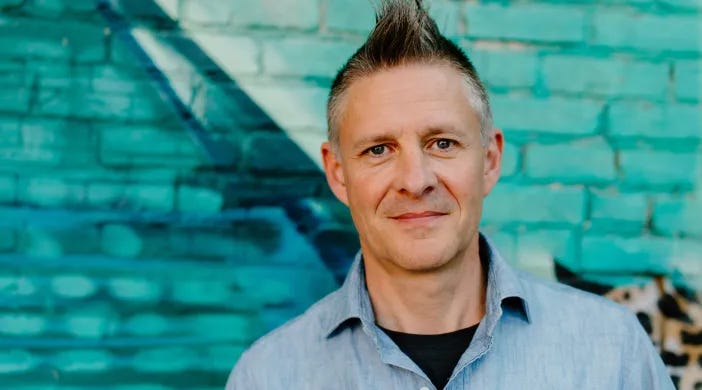
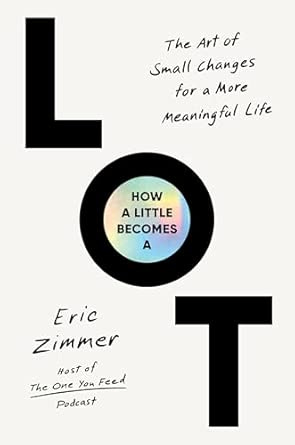
Eric Zimmer is the host of one of my favorite podcasts “The One You Feed”. He is such a wise guy and a friend. Which is why I was excited to see his new book “How a Little Becomes a Lot: The Art of Small Changes For a More Meaningful Life”. I appreciate that he took the time to do a little interview with me!
SBK: How do you honor the real reasons you are the way you are without letting those reasons become your identity?
EZ: I think this is one of the central challenges to being human. We all have explanations for why we are the way we are. It could be temperament, family, trauma, culture, biology. Each of us gives those different factors different weights, but most of us know we are a combination of those things.
But an explanation is not destiny. The real danger is when those explanations turn into self-concepts. I’m an anxious person. I’m broken. I’m a hopeless addict.
One of the key ideas that runs through my book is that change happens when self-understanding and self-responsibility meet.
It’s not one or the other. We usually need both. Understanding drives compassion, which is important in our ability to change. Responsibility drives action, which is equally critical.
These questions are often hard to discern alone, which is why having trusted people in our lives that we can talk to is so valuable.
SBK: A lot of people have insight into why they struggle, but still don’t change. Why doesn’t understanding ourselves automatically lead to transformation?
EZ: Insight is important, but it is vastly overrated.
If you were watching the movie of my life, the pivotal scene would show a dingy yellow room in what was once a tuberculosis hospital in Columbus, Ohio, in the winter of 1994. A counselor would be talking to a young man slumped in exhaustion, looking equal parts frightened and lost. Me.
I weighed one hundred pounds, my skin jaundiced from hepatitis C, with the shadow of fifty years in prison hanging over me. I was a homeless heroin addict at the end of his road, and even I could smell the despair on my own skin.
“Eric, you need to go to long-term treatment,” the counselor told me.
“No, thank you,” I said, summoning what little dignity I supposed I had left. Then I dragged myself up and slouched down the hall like the wounded animal I was.
Back in my room, I had what they call a “moment of clarity”—that moment of insight—as I looked out my clouded window at cold gray skies. It was a few days before Christmas. I realized with sudden, terrifying lucidity that my current path led only to death or prison. Dope sick, shaky, and afraid, I turned, walked back down the hall to that yellow room, and opened my mouth before I could change my mind. “Okay,” I said, “I’ll go to your treatment.”
That would be the high-drama, dark-night-of-the-soul turning point in the movie of my life. And it was an important moment—but it’s also anything but the full story. In getting from that wounded place to where I am today, that scene is not as monumental as it may seem. Deciding to enter treatment would be nothing without the countless tiny decisions I made day after day, year after year afterward: deciding not to take the route past that bar, calling my sponsor instead of my dealer, showing up to a meeting when every cell in my body wanted to stay home and hide.
When we think about life-changing events, we tend to think in the singular. The epiphany. The miracle. The watershed choice that will put us on a new trajectory for good.
But that’s not how real change happens for most people, most of the time. It happens little bit by little bit, with a thousand chances to do A or B, each choice a thread woven into the fabric of who we become.
The story of me getting sober in the movie would be a classic recovery montage—gritted teeth, a couple of shaky smiles at a support meeting, a swelling soundtrack as I turn down a dealer’s offer. A few quick scenes and suddenly I’d be transformed.
But the reality can’t be abbreviated, because it is what happened in the long stretches of time the camera would never capture that turns out to make all the difference.
We need insight, but we also need the slow, steady accumulation of actions over time to make the insight into reality.
SBK: What’s the difference between self-awareness and self-preoccupation—and how do we know when we’ve crossed that line?
EZ: This is really tricky, and it’s a common trap. We do need self-awareness, and often that takes priority for a while.
There is a question that I use often in this, and it’s asking myself: “Is what I’m thinking about useful?”
There is a point where yes, I am gaining self-awareness. I am thinking of different strategies to handle the situation. I’m coming up with alternative approaches. I’m having new insights.
If I’m thinking about myself in a way that leads to better choices, more compassion, more honesty—great.
But then there comes a point where nothing new is happening. I’m just looping, rehearsing, analyzing, and staying stuck. I feel myself getting smaller and more contracted.
And at those moments the most healing thing isn’t more introspection—it’s doing the next right thing. It’s taking an action. It’s getting up and going outside. It’s reaching out to a friend for a new perspective.
This is really hard because thoughts get caught in loops and become obsessive.
But it’s a really important first step to start recognizing when it’s gone from useful to not useful. From there you can develop better strategies to move on from them.
SBK: You write a lot about small change. Why do people so often dismiss small actions when, in practice, they’re usually what actually change us?
EZ: Because who wants a lot of steps in a long process of change when you could have fifteen years of therapy compressed into one hour, which is the new thing I see on Instagram all the time? 😂
We want things faster and we want them easier. I think that is true for all of us.
I know those claims are ridiculous, and yet I feel myself drawn to them.
But the reality is, for most people most of the time, change happens one little bit at a time. The good news is that that dramatic change is indeed possible. Let me tell you what I mean.
I had been sober for about a week. I had been in detox and come home for Christmas. The game was over, the jig was up — I had told my parents and the people in my life I was an addict, and I was convinced that I wanted to be clean. As short a time as a week sounds, those first seven days are a big deal for any recovering addict, and that night I believed that it had been the first week of the rest of my clean and sober life. I went to a recovery meeting and came home. And then things took a small, disastrous turn.
There in the mail was a gift from my grandfather. Twenty-five dollars. At that time twenty-five dollars was the magic number (for a shot of heroin).
Instantly I felt an overwhelming craving to use. I didn’t want to, and at the same time I did. To this day I don’t know of a worse feeling than that sensation of being torn in two. One part of me screaming, “Don’t do it!” and another part screaming, “I have to do it!”
I paged my dealer, and he agreed to meet me in one of our five or so shitty regular spots around Columbus.
I remember driving there. It was snowing, and I was sobbing in the car. “Dream On” by Aerosmith was playing on the stereo. With every turn signal a fresh wave of shame broke over me, and yet it felt like an invisible, malevolent hand was steering the car down the road.
We can leave that particular story there. You know how it ends.
Now here’s the other side. Twenty-five years later, I was picking up opiates from the pharmacy and delivering them to my mother week after week. Oxycontin, to be specific. The good stuff. Once upon a time I might have robbed you at gunpoint for them, and now they had no more emotional significance to me than a loaf of bread.
I don’t tell those two stories to brag. I tell them to show just how different we can become, and how something that seems impossible now can become second nature down the line if we commit to the long process of change.
Very wise! Thanks. I’m sharing this with others!
With the right mental framework, we can all go through radical personal change, even if we have our weak moments when we take two steps forward and one step back. Loved this post.