

My friend Krista Stryker writes the amazing Substack blog “On Fire”. It deserves more attention. She has interviewed over 100 people from wildly different backgrounds — from bonsai masters and dragon boat helms to bean entrepreneurs and pigeon rescuers— to find out what lights them up and how they stay that way. Krista is also an author, athlete, entrepreneur, and co-founder of the Institute of Aliveness (a global interdisciplinary institute exploring how we can all build more life in our time).
Krista and I talk a lot about passion. A big theory in positive psychology is Robert Vallerand’s dualistic theory of passion. Vallerand has shown that harmonious passion (an autonomous internalization of a passion) predicts lots of positive outcomes compared to obsessive passion (a controlled internalization of an activity in one’s identity that creates an internal pressure to engage in the activity that the person likes). Most of Vallerand’s research is looking at between-person differences, however. As Krista points out in her latest blog post, within-person analyses suggest that very few people who are passionate about something are completely harmonious and not obsessive at all.
Quite the contrary. I mean, have you seen Michael Jordan!? It seems like there needs to be a new within-person category we call “harmoniously obsessive”. This seems to characterize the all-consuming energy many high achievers have for their passions while also acknowledging that the activity still makes them feel good about themselves and is freely chosen and internally driven (i.e., harmonious).
Enough summarizing Krista’s work. She was gracious enough to let me reprint her post here. Anyone here also harmoniously obsessive about an activity? Let us know!
—
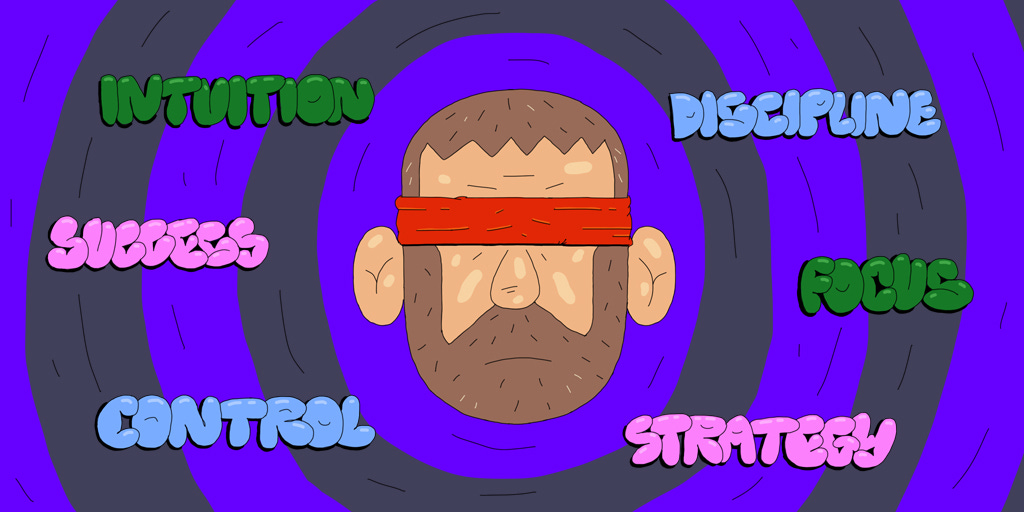
“I am a man of vehement disposition, with violent enthusiasms, and extreme immoderation in all my passions.” — Oliver Sacks
The other day, after an hour of grueling takedown practice, my jiu-jitsu coach, Rodrigo Freitas, gave the class a few minutes to catch our breath. As the twenty-something of us in the Monday morning competition class wiped the sweat from our foreheads and chugged electrolytes at the edge of the mat, he sat cross-legged in the middle of it and waved us quiet.
“Most of you want to compete,” he said, looking around the room. “You all have different goals. Some of you are young, with big dreams in jiu-jitsu. Others have full-time jobs, but you do this on the side to challenge yourself and stay healthy. Others of you just want to relax.”
(I stifled a laugh at that last one. It takes a certain kind of person to find jiu-jitsu “relaxing.”)
Whatever path we were on, he said, he wanted us to take it seriously.
“The people I know at the very top? They’re obsessed. They do everything they can to maximize their chances of performing well. If they have a competition coming up, they don’t think about anything else. All they do is train, eat, and sleep. They put on blinders.” He brought his hands up to his eyes as he said this, mimicking horse blinders.
“Maybe your goal isn’t to be at the very top. But be honest with yourself. Can you try and get even a .001% advantage? Can you go to sleep just a little earlier each night? Can you commit to eating healthy two months before the big competition? Can you be a little more obsessed?”
As I drove home from training that day in a kind of happy exhaustion, I kept turning the speech over. In a world so often focused on balance and self-care, his call for more obsession felt like relief. When I say no to spontaneous dinners or late nights out to focus on my jiu-jitsu or writing, sometimes I feel, as my illustrator niece Lily would say, like a “cuckoo odd duck.” Rodrigo reminded me that there’s a whole room of us — people who have chosen a narrow life on purpose.
It also sent me back to the research. What does psychology have to say about this kind of intensity?
For most of its history, psychology left passion to the philosophers, who focused mostly on the romantic kind. No one studied the deep, long-term devotion to a craft, a sport, or a cause we love and pour our finite energy into. That all changed in the late 90s, when the Canadian psychologist Robert Vallerand started looking.
Vallerand had played basketball in university. When he eventually pivoted to academia, he gravitated toward intrinsic motivation because it was the closest thing psychology had to what he had felt on the court. Then he realized nobody in psychology had studied the love for the thing itself. In 2003 he published the Dualistic Model of Passion and opened a field. He split the fire in two, according to how the thing got absorbed into your identity: harmonious passion, which you take up freely, no strings attached, and obsessive passion, which you take up under pressure — from ego, from needing to be seen a certain way, from an excitement you can’t control.
Almost everything written about passion since inherits that split. Harmonious is the “good” kind — the kind you can set down, that doesn’t keep you up at night. Obsessive is the “bad” kind — the kind that takes over your life and burns you down. But I’ve spent years interviewing people about the things they can’t stop doing, and the ones who’ve stayed the longest look a lot more like the “bad” kind. (So do I. I once spent seven years tweaking the weight distribution in my fingers to perfect a handstand, and I’ve flown to Paris and Brazil to lose jiu-jitsu matches.)
I haven’t talked to Vallerand (I’ve reached out several times over the years — he politely declined once and hasn’t replied since). But in print he is pretty clear on the split. Harmonious is desirable; obsessive is not — though he insists that any passion, even obsessive, beats none at all. He sees harmonious passion as the best of all worlds:
When people “choose the more harmonious way to engage with their passion activities... that’s when they can have their cake and eat it too,” Vallerand explained on a podcast. “You can work hard… still have a life and be happy.”
But almost nobody manages it. When researchers sorted more than seven thousand workers by how their passion actually combined, the textbook “good” profile — high harmonious passion, low obsessive — turned up in under eight percent of them. The most common profile, in every group they looked at, was the one where obsession ran the show.
You could argue that’s a work problem. But I’ve interviewed people across startups, bonsai, and triathlons, and the pattern underneath looks the same in all of them.
Rodrigo describes the same thing. The best competitors, he says, put on blinders — shielding themselves from the distractions of a normal life. If their best friend’s birthday party falls close to a competition, they’ll celebrate after. They’re that locked in. Vallerand would call that conflict. It looks more like dedication to me.
“When harmonious passion is at play, individuals do not experience an uncontrollable urge to engage in the passionate activity,” Vallerand writes in a 2008 paper on the psychology of passion. “There should be little or no conflict between the person’s passionate activity and his or her other life activities.”
He offers the example of a professor with a deep passion for music:
“When confronted with the possibility of playing music (jamming) with his friends or preparing tomorrow’s talk, the professor with a harmonious passion toward music can readily tell his friends that he’ll take a rain check and proceed to be fully immersed in the preparation of the talk without thinking about the jam session.”
And yet I’ve rarely met a musician (or anyone deeply committed to their craft) who lets go that easily.
When I talked to fingerstyle guitar legend Mary Flower, she said she’d lost a lot of the “normal” parts of life to her five-decade career in music.
“I don’t have a lot of hobbies,” she told me. “I don’t do pottery. I don’t do yoga. Life is pretty much all music.”
My painter friend David Eddington said something similar. He’s up at 4:00 a.m. to paint most mornings.
“That’s probably why I get up: because I’m thinking about what I’m doing all the time. So I think, ‘What’s the point in lying in bed?’”
I know the feeling. When I’m swept up in a passion, the alarm is a formality. The thing I love is always on my mind. Which is supposed to be the warning sign.
Except the loophole comes from Vallerand’s own lab. In a study of elite adolescent hockey players, his team found that the obsessively passionate ones only did worse in diluted environments — recreational leagues where their intensity read as too much. Those same athletes in highly competitive rooms with equally obsessed players thrived. Better, even, than the harmoniously passionate players beside them. (It was a small study and didn’t run for very long. But it tracks with what people actually tell me.)
So maybe intensity isn’t the problem. The room is. Rodrigo’s Monday morning class isn’t a pressure cooker. It’s a room built for people who can’t stop thinking about the same thing.
The psychologist Scott Barry Kaufman is a friend. Over the six years I’ve known him, I’ve watched him fall hard for mentalism, a psychological branch of magic. He’ll easily spend an entire day practicing card tricks. He once spent nearly eighty hours preparing for an informal show in his Santa Monica living room.
When I asked Scott if mentalism had gone obsessive, he didn’t apologize.
“I think I’m both harmoniously and obsessively passionate,” he told me. “They’re not necessarily at odds with each other. I have healthfully integrated [mentalism] into the core of my identity — which is harmonious passion. But it also keeps me up at night. I can’t help but come up with new ideas.”
Somewhere in those conversations, we gave the blend a name: harmonious obsession. It’s what happens when you are completely, monomaniacally captured by the thing you love, but the capture is fueled by wonder and curiosity rather than ego or fear. Vallerand would say those are already his two categories — that wonder produces the harmonious kind and ego produces the obsessive kind, and that the good fuel comes bundled with the ability to walk away. That’s the part I don’t believe.
Harmonious passion is defined by what you can walk away from: the jam session you skip, the thing you set down when something more important comes up. But I’ve interviewed a lot of people who have stayed on fire for decades, and almost none of them describe their passion as something they can set down. Mary Flower didn’t build fifty years of music by taking rain checks. David isn’t up at four because he’s disciplined. They do exactly what Rodrigo asked of the class. They put on blinders, and they leave them on.
All I know is that the happiest stretches of my life have been the ones where I blocked the rest of the world out and pointed myself at one thing. Sometimes the most life-giving thing we can do is to quit chasing balance, pick the narrow, bumpy path, and let the obsession win.

Oh, I love this article, Scott; thank you. I wanted to push a little on the framing. The within-subjects findings don't require a completely new class of variables, but rather identify an issue in conceptualizing harmonious and obsessive passion as ends of the same continuum. Vallerand's model treats them as two separate internalisation processes that can coexist; the between-person correlational work just made it easy to read them as a trait spectrum, with Jordan at one end and the well-adjusted hobbyist at the other. Most of us are somewhere in the middle, and not steadfastly so.
What I see in high performers I work with is that the balance shifts with the state of the person rather than the person themselves. For example, the same surgeon can hold a difficult case with full passion and genuine self-endorsement on Tuesday, and be driven by dread of failure and an inability to leave it alone on Thursday. Nothing about the passion changed. The regulation did.
So I would be cautious about "harmoniously obsessive" as a firm type. It risks flattering the all-consuming version of high achievement, and Jordan is a difficult witness: the drive was extraordinary, but so was the cost, and the Hall of Fame speech suggests the grievance was doing a fair amount of the work. Obsessive passion produces excellent output for a long time before the bill arrives.
The more useful question, I think, is what allows someone to be totally consumed by an activity and still able to walk away. That's an emotional agility question more than a passion-type question, and it's a within-person one by definition.
To answer your question: Yes, I am passionate about writing and cannot wait to put my thoughts on paper, but some days it's harmonious, and some days I am not sure I would pass the test.
Here's a little poem from Octavia Butler:
Love quiets fear.
And a sweet and powerful
Positive obsession
Blunts pain,
Diverts rage,
And engages each of us
In the greatest,
The most intense
Of our chosen struggles.