

Before we dive in today — a quick heads-up: I'm going live with David Epstein, author of the new bestseller Inside the Box, on Friday, June 26 at 3:30pm PT. (If you caught some duplicate invites a few days ago — sorry, I’m still figuring out how to set these up — this is the real one →) https://substack.com/live-stream/249996. Add it to your calendar and come hang out with us!
I want to clear up a misconception I see everywhere in cognitive neuroscience, including in published papers that really should know better.
The misconception goes like this: There’s a seesaw in your brain between the Default Mode Network, which I prefer to call the Imagination Network, and the Executive Control Network. More technically, the idea is that these two networks are “anticorrelated”: The more you turn inward to your rich imagination, the story goes, the more you inhibit your capacity to focus and execute. And the more you engage your executive control, the more you mute your inner stream of consciousness. Inner life and getting things done, locked in opposition.
Guess what? It ain’t true.
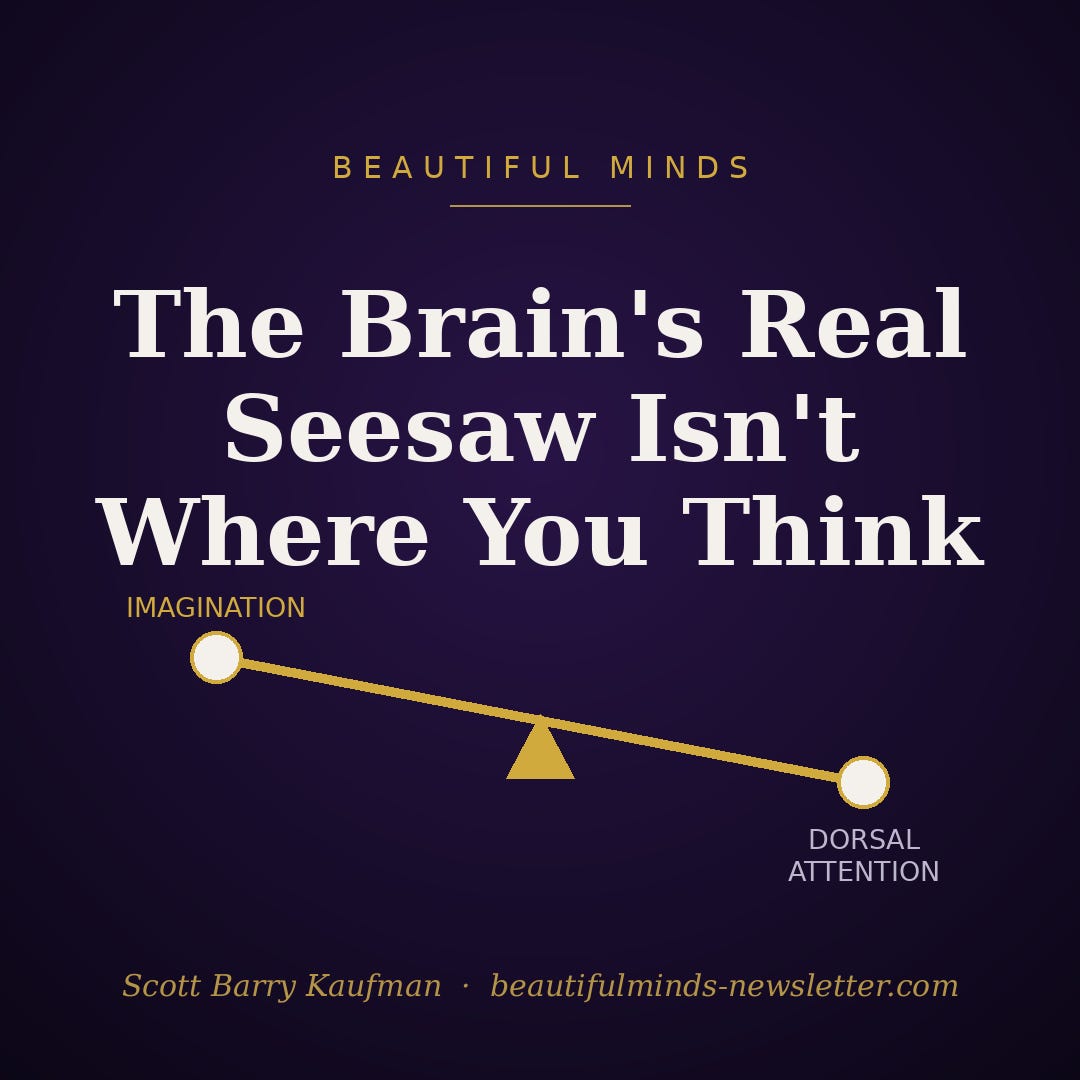
The real seesaw isn’t between the Imagination Network and executive control. It’s between the Imagination Network and the Dorsal Attention Network, the system that activates when you direct your attention outward, onto a task in the world in front of your eyes. Those two networks do tend to sit at opposite ends of the seesaw when the brain is at rest. So the basic finding is real. It just had been pinned on the wrong network!
Why does this matter? Well, here is where things get genuinely interesting. A beautiful study by Matthew Dixon, Jessica Andrews-Hanna, Kalina Christoff, and their colleagues (NeuroImage, 2017) took this supposed iron law and actually tested how stable it is. They found it is far more flexible than most neuroscientists assumed.
Three findings stood out.
First, the Dorsal Attention Network is only anticorrelated with the core of the Imagination Network, the part recruited when you reflect on your autobiographical self. It is not anticorrelated with the other subsystems, the ones involved in mentalizing (thinking about other minds) and the retrieval of deeply personal memories. So even the real seesaw is partial. Most of your imagination isn’t even on it.
Second, the anticorrelation that does exist varies enormously depending on what you are doing. The networks slide between competing and cooperating across different cognitive states, and even moment to moment, flipping between anticorrelation and positive correlation over time, far more than the tidy “competing systems” story allows.
Third, and this is my favorite part: what predicts whether the two networks compete or cooperate is the frontoparietal control network, the executive system itself. It acts as the moderator, deciding when to pull the networks apart and when to integrate them, depending on what the task actually demands.
What does all of this mean in plain English? A few implications off the top of my head:
1. Executive control is not just for the outside world. The Executive Control Network gets described as the network responsible for paying attention to what’s outside of you. But that is actually the Dorsal Attention Network’s job. Your executive control can focus you on your inner stream of consciousness just as powerfully as on external input. I was mentored in graduate school by Jerome L. Singer, the father of daydreaming research, who found that we can be intensely mindful of our daydreams and put them to remarkably productive and creative use. Focus and imagination are not enemies. They are collaborators.
2. There is no strict wall between inner and outer processing. Even the Dorsal Attention Network can couple with the Imagination Network, especially the mentalizing and memory subsystems. Think about it this way: the network that holds your most personal memories can steer your attention out into the world. Walk into the kitchen of a grandparent who has passed, and your memory of baking with them there pulls your eyes straight to their old mixing bowl on the shelf. A deeply personal recollection, reaching outward to aim your attention at something real in front of you.
So these supposedly “opposed” systems actually work together quite often, and the executive network is what flexibly keeps them apart or brings them together, depending on what the moment calls for.
3. The anticorrelation we do have is mostly a gift. I actually think it is a good thing that the core of the Imagination Network and the Dorsal Attention Network tend to sit on opposite ends of the seesaw. As Andrews-Hanna and colleagues suggest, this shielding may protect your abstract self-reflection from being constantly interrupted by raw perceptual input. In other words, it may be part of how you keep “what I am seeing out there” distinct from “my sense of who I am.”
I have written about this link between creativity and mental illness for many years: in Scientific American, in Psychology Today, in a scholarly piece with the philosopher Elliot Samuel Paul in Frontiers in Psychology, and among many other publications on the topic. The common thread across all my articles on the topic: creativity and psychosis-proneness seem to share an underlying ingredient, a reduced ability to suppress the precuneus, a hub of the Imagination Network, so that more raw material floods into conscious awareness.
That porousness is a gift when you can steer it and a hazard when you cannot. What turns the same flood into creativity rather than chaos is the executive steering we have been talking about, the protective control that selects the useful ideas and lets the rest go. So my hunch is that when the separation between these streams breaks down too far, as it may in conditions like schizophrenia, they become genuinely hard to tell apart.
There are many more implications than I can fit here, but the headline is simple, and it matters: your imagination and your ability to focus were not designed to be at war. The brain that dreams and the brain that steers are built to work together, and most of the time, they do it beautifully (this is a great example of an article perfectly dovetailing with the title of this newsletter).
This is exactly why I keep arguing that the Imagination Network is the protagonist of your inner life, not its villain. And it is why creativity, in the research I have done with the neuroscientist Roger Beaty and others, turns out to depend on these networks coupling into an integrated whole rather than one “defeating” the other.
The seesaw is real. We have just been watching the wrong end of it.