

My colleague Todd Kashdan woke up today and chose to criticize my life’s work. I texted him to thank him for doing that. :) First, read his article, then come back and read this response.

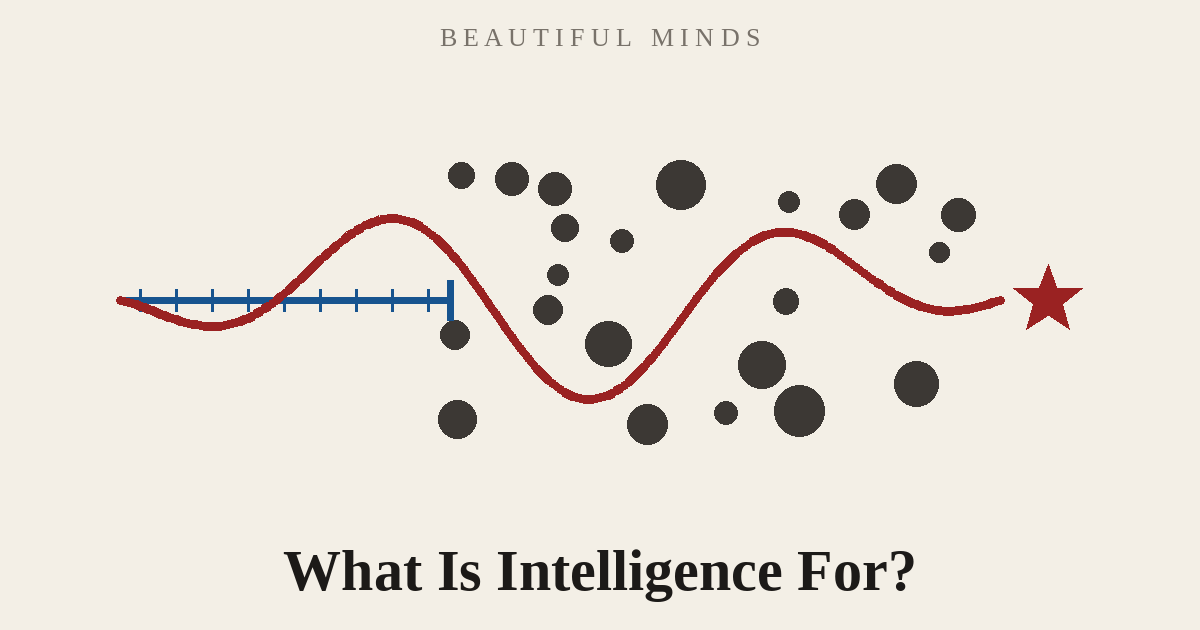
Virtually my entire life (as long as I can remember) I have been grasping for a new definition of intelligence. Yes, this started in elementary school, observing people on the playground and trying to understand what made some people more intelligent or talented than others. What I was grasping for was not a new theory of “multiple intelligences”. I also wasn’t grasping for a theory that completely ignored the value of IQ. But something else. Something that would serve as a marker of functional intelligence. Not your capacity, but what a whole, breathing, alive human does with whatever they have.
My first public crack at it was put forward in my 2013 book Ungifted: Intelligence Redefined, where I defined my theory of “Personal Intelligence” as follows:
Personal intelligence is the dynamic interplay of ability and engagement in pursuit of personal goals over time.
I tried to make clear in that book that what I was calling Personal Intelligence* was not the same thing as General Intelligence. In fact, I have a lengthy and complex chapter in the book on the much-debated “g factor” and I make clear that the scientific study of g (for General intelligence) is fascinating and that most modern IQ tests do a pretty good job of measuring g. In that chapter, I argued that the essence of g is pattern detection ability that requires conscious working memory capacity. This is indeed a generalizable skill, earning its name General Intelligence.
When I wrote Ungifted, I had not made contact with the field of positive psychology yet and even more importantly, I hadn’t made contact with the field of humanistic psychology. When I discovered the writings of Abraham Maslow, I lit up and realized that what he was referring to as “the need for self-actualization” is what I was grasping for in Ungifted.
If you ask people what they really want out of their lives, very few people will say an extra few IQ points. What they will mention are things like having a purpose, finding meaning, becoming all that they can become with whatever capacities they have. To me, being able to move toward self-actualization counts as a form of intelligence! Which is why I now call my theory the theory of “Self-Actualizing Intelligence”.
Why put self-actualization in the realm of intelligence? For a number of reasons. For one, the founder of the field of academic psychology, William James, drew an important boundary 135 years ago in Chapter 1 in the founding text of American psychology.
“The pursuance of future ends and the choice of means for their attainment are thus the mark and criterion of the presence of mentality in a phenomenon.”
— William James, The Principles of Psychology (1890), Vol. 1, Ch. 1, “The Scope of Psychology”
William James’s examples are Romeo finding alternate routes to Juliet, and a frog navigating obstacles to reach air. These examples are all about flexible pursuit, which I believe is a very important form of intelligence. Also, that’s precisely the line between my theory of self-actualizing intelligence and a popular definition of intelligence by Naval that Todd Kashdan criticizes in his article: “The only real test of intelligence is if you get what you want out of life.” I don’t put my theory of intelligence in Naval’s camp whatsoever, and I share Todd’s criticism of Naval’s definition. To be clear: I am not scoring the outcome, I am scoring the pursuit (the dynamic interplay that affords one to move toward self-actualization).
Now, let’s talk about Binet. Todd praises Binet’s definition of intelligence which I will quote here:
This faculty is judgment, otherwise called good sense, practical sense, initiative, the faculty of adapting one’s self to circumstances.” - Alfred Binet, The Development of Intelligence in Children (1916 trans., pp. 42-43).
I would argue that this is actually a functional definition of intelligence, which is exactly what I was grasping for. I am a big fan of Binet, who is a major hero in my book Ungifted. Binet emphasized that intelligence is not a fixed-quantity and can change over time. That’s what inspired me to put forward a developmental definition of intelligence.
In his article, Todd criticized my inclusion of “engagement” in my theory of intelligence. I agree with Todd that engagement is not as part and parcel of General Intelligence (although I would argue that engagement is more important for the development of General Intelligence than intelligence researchers have given it credit). But I do view engagement as essential for Self-Actualizing Intelligence. I don’t believe IQ tests do a great job measuring the form of intelligence that comes from deep within.
The context here is that in my book Ungifted I had just finished cataloguing all the beautiful minds that have done extraordinary feats of mental magic despite not having a sky high IQ. This included stories of what happens to students who become “activated” and are given resources to pursue their loftiest dreams (or more boringly, “goals”). Again, I’m not dismissing IQ as a valuable tool. But I am proposing a different tool that I think is just as real.
Now, I’d like to conclude agreeing with what I think is Todd’s best point. In my view, Todd’s strongest sentence is that Linda Gottfredson’s definition of intelligence requires “no healthy downstream outcomes”. In other words, capacity shouldn’t be defined by how life turned out. I agree. Again, Self-Actualizing Intelligence isn’t defined by outcomes either— it’s defined by the quality of pursuit: self-concordant goals, harmonious engagement, talent meeting a resonant passion. A brilliant pursuit that fails is still utilizing Self-Actualizing Intelligence. I believe this is where Todd and I converge. In fact, I think Self-Actualizing Intelligence shares deep features with Todd’s own model of psychological flexibility.
Thanks to Todd for stimulating this discussion and making me clarify some of my positions. I think we’re all the better off for the exchange.
* Unfortunately, my Theory of Personal Intelligence turned out to share the same name as another researcher’s new theory of intelligence around the same time and I was unaware of that as I was writing the book! As Todd points out, our theories of intelligence are pretty different from each other.
Scott and Todd. Brilliant discussion. It’s one I will read again from both of you convergence and divergence from two men I admire. And it’s delightful to see your friendship and camaraderie amidst your different views and definitions of intelligence. I’ve given several thousand intelligence tests in my clinical psychology life, and the metaphor that came to mind was runners (gifted or not gifted) at the starting block, ready to run the race. It takes a great deal of motivation courage, self-actualized beliefs and many other personality factors to get to the end of the race. Then there’s the whole concept of winners and losers even a brilliant runner comes in second or third thanks for an extremely important conversation.
Thanks Scott & Todd for this discussion. As a therapist, it makes me think how often we are helping people whose inner mind's coping holds back their "Self-actualizing intelligence" so they can make use of their (g) general intelligence to find more satisfying lives. For that reason, the two measures help project how life could be. And it makes me want to say that "success" in worldly pursuits, as a "downstream outcome," depends a lot on self-actualizing intelligence rather than the g type of intelligence.