

“People don’t buy what you do; they buy why you do it.” ~ Simon Sinek
“Connection is not about how much time we spend together. It’s about how much joy and meaning we create together.” ~ Adam Grant
“You do not rise to the level of your goals. You fall to the level of your systems.” ~ James Clear
“Vulnerability is not winning or losing; it’s having the courage to show up and be seen when we have no control over the outcome. Vulnerability is not weakness; it’s our greatest measure of courage.” ~ Brené Brown
This rhetorical move has taken over the bestselling tier of self-help writing in the last decade. And it’s driving me bonkers!!!! I’m reminded of this brilliant meme:

The formula is everywhere. And I mean everywhere— in a TED talk, or a new subtitle of a book, or the close of a paragraph. Often it is the entire structure of an argument — an old idea named, a new idea installed, the door shut behind it. The author looks like a person who has Figured Things Out. They smile smugly. I mean, you thought it was that, but this person really knows it’s this. The reader gets a clean takeaway. The book sells.
I think the formula is cheap rhetoric, and I think we should all stop respecting it.
It is not cheap because the underlying claims are always wrong. Sometimes they are partly right. Practice does matter more than talent in the long-run. Willpower does have limits, and systems do help. Identity does matter more than goals for some forms of behavior change. Tone can shift the impact of a message. Each of the individual claims, taken loosely, is often defensible.
The formula is cheap because it pretends that the world is two-positioned when it isn’t. It pretends that one thing is true and the other thing is false, when both things are usually true at the same time. It models, for the reader, a kind of binary cognition that life simply does not run on. And it does this in service of selling books and Instagram quote-cards, not in service of describing reality.
What the binary flip is doing under the hood
The “it’s not X, it’s Y” formula is a compression device. It takes a complicated truth — say, the relationship between willpower and behavior — and replaces it with the appearance of a clean reveal. The reader feels they have learned something. The writer feels they have taught something. The book feels readable. Everyone walks away artificially satisfied.
The price, which most readers don’t notice because the trick is so smooth, is that the actual relationship between the two things has been erased. Willpower AND systems both matter. Heck, they even interact and can compensate for each other across time. The deeper question — when willpower runs out, what kinds of systems work for which kinds of people, where the fine balance between effort and structure actually lies — has been replaced by a punchline.
There’s no doubt it sells. Binary flips are screenshot-friendly. They quote well. They fit on Instagram and get noticed easily on LinkedIn. They get retweeted. They appear on book covers as subtitles. The genre rewards them, the algorithm rewards them, the reader has been trained to look for them.
It’s the same with the constant trope that it’s not talent but practice. In truth, talent multiplies the capacity for practice. It’s both. Talent and practice operate in a complex interplay that constantly fuel and drive each other. That’s just the truth. But that just doesn’t make as catchy a bumper sticker.
I could go on and on with examples. When you read enough of these articles or books, you stop being able to think about willpower and systems or talent and practice at the same time. You start to believe, dimly, that every psychological concept is in competition. That is not because you are a worse thinker than you used to be. It is because the books have trained you to expect a winner. (Doh, I did it again!)
Most of life is YES/AND
After twenty-five years of studying human potential, I’ve come to believe that the most important things in a human life are almost always both, not either. They are and, not or. They are held in tension, not resolved by choosing a side.
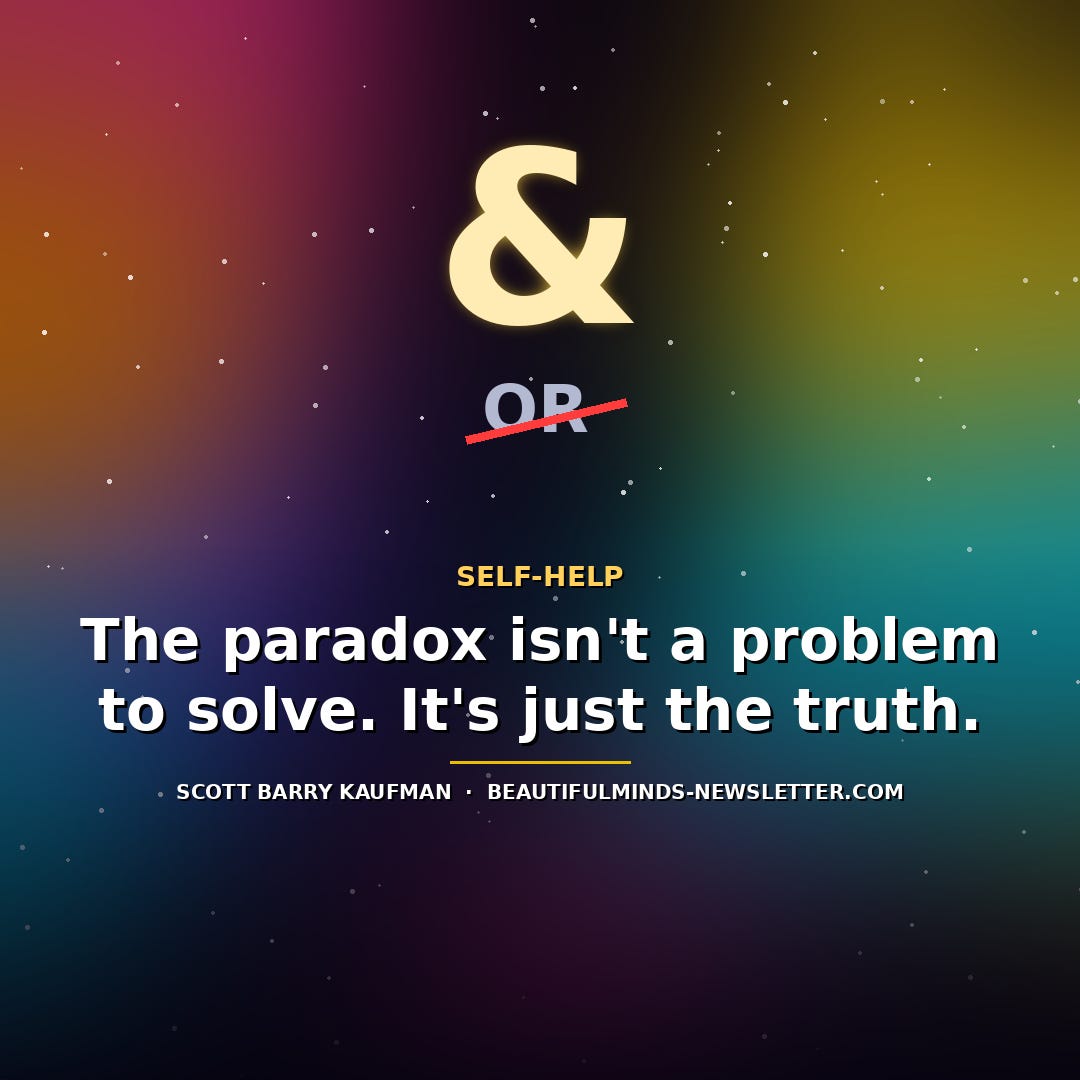
Creative people, in the research my collaborator Carolyn Gregoire and I gathered for Wired to Create, are not focused OR open. They are focused AND open, alternately, on demand. Mindful AND mind-wandering. Playful AND serious. Sensitive AND resilient. The paradox is not a problem to solve. The paradox is the truth.
The empowerment mindset I wrote about in Rise Above is structurally a yes/and. Yes, I have suffered AND I am still responsible for what I do next. Yes, the world has treated me unfairly AND I am not absolved by that unfairness from doing my own work. The yes/and is the mindset that lets you take both halves of the truth at the same time without collapsing one into the other. It is the difference between a person stuck in a story and a person growing through one.
Maslow’s later work, which I tried to update for the twenty-first century in Transcend, is structurally a yes/and. Yes, the lower needs — safety, belonging, esteem — matter, real and ongoing across a whole life. AND, the higher needs — growth, self-actualization, self-transcendence — are not earned by completing the lower ones. They work in tandem. Both, dynamically, across a lifetime.
The world is full of yes/and structures: nature and nurture, head and heart, work and rest, selfishness and altruism, optimization and soul. The list goes on. The humanistic psychologist Abraham Maslow argued that the hallmark of “transcenders” is the capacity for dichotomy transcendence, to be able to integrate dualities into superordinate wholes and see the bigger picture sitting above the false binaries. It’s not our default way of thinking about anything, but in my humble opinion it should be our default way of thinking about everything!
What we lose
Here is what I think is at stake.
When the binary flip becomes the dominant register of self-help, two things happen.
The first is that readers stop being able to hold contradictions. The capacity to keep two things true at the same time — which is, by the way, the basic precondition for any kind of mature thought — gets trained out of people. Every paragraph teaches them to expect a winner. The world doesn’t have winners. The world has dynamic relationships. People who can no longer think in dynamic relationships do not grow.
The second is that the actual debates that matter get cheapened. The real arguments inside contemporary psychology — about how to integrate trauma without collapsing into victimhood, how to honor sensitivity without pathologizing it, how to value optimization without worshipping it — are subtle, contested, and often unresolved. They cannot be summarized as “it’s not X, it’s Y.” When the genre demands that they be, they stop being available to general readers. The conversation flattens.
Both are losses. Both are happening.
And now the machines have learned it from us
Here’s the part that turned my annoyance into something closer to alarm. That “it’s not X, it’s Y” move is now the single most recognizable fingerprint of AI writing. The Atlantic just ran a whole piece on it. The detection company Pangram finds the construction shows up about three times as often in AI text as in human text. One analysis clocked it more than quadrupling in corporate communications between 2023 and 2025. Every major chatbot reaches for it, constantly. AI is beyond obsessed with this way of talking. And you know whose fault that is? It’s our fault!!!!
These models were built by digesting the internet — including a decade of exactly the bestselling self-help prose I’ve been complaining about. When human reviewers scored the machines’ drafts, they kept rewarding “it’s not X, it’s Y,” because it feels like insight — the same reason the genre has rewarded it for years. The machine picked up the hollow reveal from the loudest and most confident voices in the room, and then it handed that reveal back to all of us at industrial scale.
AI trains on text soaked in the formula, which deepens its taste for the formula; the internet fills with more of that text; and researchers are already catching the cadence creeping into ordinary human speech. We taught the mirror to talk, and the mirror is teaching us back.
Which lands somewhere strangely hopeful. If you want AI to write with more soul, look at what we feed it — because the training data is us. The register we make dominant is the register the machines will hand our kids. So for me this stopped being a matter of style. How we choose to write is now, in a small but genuine way, how we shape what these systems become. The “and” has to start with the humans.
The yes/and as the better default
Here is what I want to propose, and what I will try my best to model in my own writing from here on out (although I'm pretty sure I’ll slip up sometimes). In fact, the irony did not escape me (and I even chuckled) realizing that the title of this essay — 'Most of Life Is And, Not Or' — is itself an 'it's not X, it's Y' construction! Caught me. The formula is so embedded in the English-language rhetorical machinery that it sneaks in even when you're arguing against it.
Truth is, Yes/and is much harder to write. It requires the writer to hold the complexity in their own head before sending it to the page, rather than offloading the work onto a rhetorical formula. It produces sentences that are sometimes longer. It produces takeaways that are sometimes less clean. It does not retweet as well.
But it is often closer to the truth (although I do admit that sometimes some things really are this, not that). And in a culture that is exhausted by being lied to in carefully arranged ways, closeness to the truth is itself becoming a competitive advantage.
So: yes, the binary flip is a useful rhetorical tool in small doses. AND, it has been so overused that it now obscures more than it reveals. Yes, some self-help writing requires compression to reach a broad audience. AND, that compression has a cost the genre rarely acknowledges. Yes, I am annoyed by the formula. AND, I have probably used it myself more often than I want to admit, and I am putting myself on notice along with everyone else.
You, the reader, can handle nuance. I am going to stop pretending you cannot. I hope the self-help industry (and AI chatbots) can do the same.
— — —
If this resonated, share it with one person you suspect has also been annoyed by the formula. And tell me in the comments: what’s an “it’s not X, it’s Y” line you’ve heard recently that you think is missing the and?
I love this topic. A favourite Niels Bohr quote I collected along the way: "The opposite of a correct statement is a false statement. But the opposite of a profound truth may well be another profound truth."
SBK, this was a fantastic piece! Thank you and I'm going to share it with my adult children. Also, it reminded me of learning "systems thinking" in grad school. Some of its core ideas are: systems are made of interconnected parts; boundaries determine what you can see; causality is often circular, not linear; mental models shape actions. Yes/and is a powerful tool in helping one see the bigger picture and more of the underlying system.